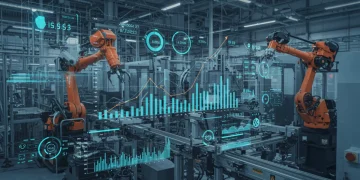
U.S. Productivity Growth: 0.7% Increase & Economic Expansion

The recent 0.7% increase in U.S. productivity growth is a vital indicator for long-term economic expansion, signaling potential for sustained prosperity through enhanced efficiency and innovation across sectors.
Understanding the dynamics of US productivity growth is paramount for anyone keen on the health and future trajectory of the American economy. The recent 0.7% increase, though seemingly modest, carries significant implications for long-term economic expansion and the overall prosperity of the nation. This analysis delves into what this figure truly means and its potential to shape the economic landscape.
The Significance of a 0.7% Productivity Increase
A 0.7% increase in productivity might appear small on its own, but in the context of a massive and complex economy like that of the United States, it represents a substantial gain in efficiency and output. This figure reflects how much more goods and services the economy can produce with the same amount of labor and capital, or even less. It’s a critical metric for assessing economic health and future potential.
This growth is not merely a statistical anomaly; it often signals underlying improvements in technology, worker skills, or organizational processes. Economists closely monitor these figures because sustained productivity growth is the bedrock of rising living standards and long-term economic expansion. Without it, economic growth relies solely on increasing inputs like labor or capital, which have inherent limitations.
Defining Productivity and Its Measurement
Productivity, specifically labor productivity, is typically defined as output per hour worked. The Bureau of Labor Statistics (BLS) is the primary source for these figures in the U.S., compiling data from various sectors to provide a comprehensive national picture. This measurement helps us understand how efficiently labor is being utilized to generate economic value.
- Output per hour: The total economic output divided by the total hours worked.
- Technological advancements: New tools and processes that enable more efficient production.
- Capital investment: Increased or improved machinery and infrastructure.
- Human capital: Enhanced skills, education, and training of the workforce.
The 0.7% uptick suggests that the U.S. economy is becoming more efficient, possibly driven by a combination of these factors. It’s a positive sign that businesses are finding ways to innovate and optimize their operations, which can lead to higher profits, better wages, and ultimately, a stronger economy.
In conclusion, a 0.7% rise in productivity is more than just a number; it’s a testament to the economy’s ability to adapt and improve. It provides a foundation for future growth and signals that the U.S. is making strides in enhancing its economic engine.
Drivers Behind the Recent Productivity Surge
Understanding what propels productivity growth is crucial for policymakers and businesses aiming to foster sustainable economic expansion. The recent 0.7% increase is likely a culmination of several interconnected factors, ranging from technological adoption to shifts in labor market dynamics.
One significant driver is the accelerated adoption of digital technologies. The past few years have seen businesses across various sectors heavily invest in automation, artificial intelligence, and advanced data analytics. These investments are now beginning to yield tangible benefits in terms of operational efficiency and output per worker.
Technology and Automation
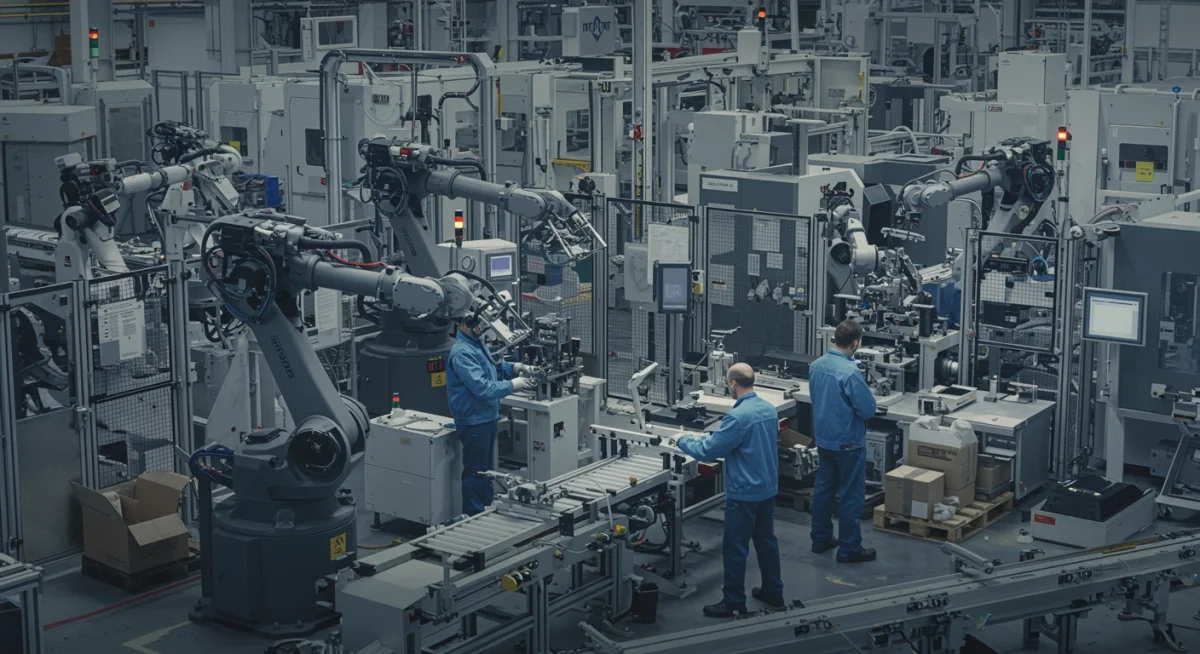
The integration of technology into everyday business operations has been a game-changer. Automation, in particular, has allowed companies to streamline repetitive tasks, freeing up human capital for more complex and value-added activities. This isn’t just about manufacturing; service industries are also leveraging software and AI to enhance client interactions and back-office processes.
- Artificial Intelligence (AI): Automating data analysis, customer service, and decision-making processes.
- Robotics: Increasing efficiency and precision in manufacturing and logistics.
- Cloud Computing: Providing scalable and flexible infrastructure for business operations.
- Data Analytics: Optimizing resource allocation and identifying inefficiencies.
These technological advancements contribute directly to higher output per hour, as machines and algorithms can often perform tasks faster and more accurately than humans, or augment human capabilities significantly.
Beyond technology, changes in workforce composition and skill development also play a role. Companies are increasingly investing in upskilling their employees to work with new technologies, thereby boosting their overall effectiveness. This human capital development is a long-term investment that pays dividends in productivity.
The recent surge in productivity can be attributed to a combination of strategic technological investments and a more skilled workforce. These drivers are not isolated but rather form a synergistic relationship that propels economic efficiency forward.
Impact on Long-Term U.S. Economic Expansion
The sustained growth of productivity is not merely a short-term boost; it is the fundamental engine that drives long-term economic expansion. A 0.7% increase, if maintained or further enhanced, can have profound effects on the U.S. economy, influencing everything from wage growth to national competitiveness.
When productivity rises, businesses can produce more goods and services without necessarily increasing their workforce or capital investment. This leads to higher profits, which can then be reinvested into further innovation, expansion, or distributed as higher wages to employees. It creates a virtuous cycle of growth and prosperity.
Wage Growth and Living Standards
One of the most direct benefits of increased productivity is its potential to drive real wage growth. As workers become more efficient and produce more value, their compensation tends to increase. This, in turn, improves the purchasing power of consumers and elevates overall living standards across the nation.
- Higher real wages: Increased productivity allows employers to pay more without raising prices excessively.
- Improved consumer purchasing power: More disposable income leads to greater demand for goods and services.
- Enhanced quality of life: Better access to goods, services, and leisure due to increased economic prosperity.
Furthermore, sustained productivity growth helps to mitigate inflationary pressures. By producing more efficiently, businesses can absorb some cost increases without passing them entirely onto consumers. This helps maintain price stability, which is crucial for a healthy and predictable economic environment.
The 0.7% rise, therefore, is not just an abstract economic indicator; it translates into tangible improvements for individual Americans and strengthens the U.S. economy’s global standing. It underpins the nation’s capacity for sustained growth and its ability to compete effectively in the international marketplace.
Ultimately, a healthy rate of productivity growth is indispensable for the U.S. to achieve its long-term economic objectives, ensuring both prosperity and stability for its citizens.
Challenges and Headwinds to Sustained Productivity
While the recent 0.7% increase in productivity is a welcome sign, sustaining such growth is not without its challenges. The U.S. economy faces several headwinds that could impede future productivity gains, requiring careful attention from policymakers and business leaders alike.
One significant challenge is the aging workforce. As a larger proportion of the population approaches retirement, there’s a potential for a decline in the overall labor force participation rate and a loss of experienced workers. This demographic shift could put downward pressure on productivity if not adequately addressed through automation or skill development.
Investment in Innovation
Another critical factor is the pace of investment in research and development (R&D) and new technologies. While there has been recent progress, ensuring consistent and robust investment is paramount. A slowdown in innovation could lead to a stagnation in new tools and processes that drive efficiency.
- Underinvestment in R&D: A decrease in funding for scientific and technological breakthroughs.
- Regulatory burdens: Policies that inadvertently stifle innovation or make it more costly for businesses.
- Skill gaps: A mismatch between the skills demanded by emerging technologies and those possessed by the workforce.
Moreover, global supply chain disruptions and geopolitical uncertainties can also impact productivity. These external factors can lead to higher input costs, production delays, and reduced access to essential components, all of which can hinder efficient output.
The digital divide also remains a concern. Unequal access to high-speed internet and digital tools can create disparities in productivity between different regions and demographic groups, preventing the full potential of technological advancements from being realized across the economy.
Addressing these challenges requires a multifaceted approach, combining strategic investments, supportive policies, and continuous efforts to adapt to evolving economic landscapes. Only then can the U.S. hope to sustain its productivity growth trajectory.
Policy Implications and Future Outlook
The recent uptick in productivity growth provides an opportune moment for policymakers to consider strategies that can solidify and extend this positive trend. Government policies play a crucial role in shaping the economic environment, either fostering or hindering productivity gains.
One key area for policy intervention is education and workforce development. Investing in programs that equip individuals with the skills needed for a rapidly evolving, technology-driven economy is essential. This includes promoting STEM education, vocational training, and lifelong learning initiatives.
Government’s Role in Fostering Growth
The government can also stimulate private sector investment in R&D through tax incentives, grants, and by fostering a competitive market environment. Policies that reduce regulatory burdens and encourage entrepreneurship can also contribute to a more dynamic and productive economy.
- Tax incentives for R&D: Encouraging businesses to invest in innovation.
- Infrastructure spending: Improving digital and physical infrastructure to support economic activity.
- Trade policies: Ensuring fair and open trade to promote efficiency and access to global markets.
- Immigration policies: Attracting highly skilled workers to fill critical labor gaps.
Looking ahead, the future outlook for U.S. productivity growth is cautiously optimistic. While challenges exist, the underlying resilience of the American economy and its capacity for innovation suggest that sustained growth is achievable. The continued integration of AI, automation, and other advanced technologies is expected to be a major driver.
However, the pace and distribution of these gains will depend heavily on how effectively the nation addresses skill gaps, invests in infrastructure, and creates an environment conducive to business growth and innovation. Policymakers must remain agile and responsive to emerging trends to capitalize on opportunities and mitigate risks.
In essence, proactive and forward-thinking policies will be instrumental in translating the recent 0.7% productivity increase into a long-term trajectory of robust economic expansion for the United States.
Global Comparison and U.S. Competitiveness
Understanding U.S. productivity growth in isolation provides only part of the picture. A global comparison offers valuable insights into the nation’s economic competitiveness and its standing among leading industrial economies. The 0.7% increase, while positive, needs to be contextualized against international benchmarks.
Many developed nations are also grappling with similar issues related to an aging workforce, technological adoption, and the need for continuous innovation. How the U.S. performs relative to these countries can indicate its long-term economic health and its ability to attract investment and talent.
Productivity Trends in Developed Economies
Historically, the U.S. has often been a leader in productivity, largely due to its dynamic innovation ecosystem and flexible labor markets. However, other nations, particularly in Asia and Europe, have made significant strides in recent decades, sometimes outpacing U.S. growth rates.
- Germany and Japan: Known for their advanced manufacturing and efficiency.
- South Korea and China: Rapidly advancing in technology and digital transformation.
- European Union: Varied performance, with some countries achieving strong productivity gains.
The ability of the U.S. to maintain and accelerate its productivity growth is crucial for sustaining its competitive edge in global markets. Higher productivity means that American companies can produce goods and services more efficiently, making them more attractive to international buyers and allowing them to command higher prices or offer more competitive ones.
Moreover, robust productivity growth enhances a nation’s attractiveness for foreign direct investment. Companies seeking efficient production environments and skilled labor are more likely to invest in economies demonstrating strong productivity trends.
The 0.7% increase, therefore, is not just about domestic prosperity; it’s also about reinforcing the U.S.’s position as a global economic powerhouse. Continued focus on innovation, education, and supportive policies will be key to ensuring the nation remains competitive on the world stage.
The Role of Human Capital in Productivity
While technology and capital investment are often highlighted as primary drivers of productivity, the role of human capital is equally, if not more, critical. The skills, education, health, and motivation of the workforce directly impact how efficiently goods and services are produced.
The recent 0.7% productivity increase implicitly reflects improvements in human capital, either through better training, enhanced working conditions, or a more strategic allocation of talent. Investing in people is an investment in long-term economic efficiency.
Education and Skill Development
A well-educated and highly skilled workforce is better equipped to adapt to new technologies, innovate processes, and solve complex problems. This directly translates into higher output per hour. Educational institutions, vocational schools, and corporate training programs all contribute to this vital aspect of productivity.
- STEM education: Fostering expertise in science, technology, engineering, and mathematics.
- Vocational training: Developing practical skills for specific industries.
- Lifelong learning: Encouraging continuous skill upgrades and adaptability.
- Workplace well-being: Promoting a healthy and motivating environment for employees.
Furthermore, employee engagement and motivation are powerful, albeit often overlooked, components of human capital. A workforce that feels valued, empowered, and has opportunities for growth is generally more productive. Companies that prioritize employee satisfaction often see better performance metrics.
The ability of the U.S. economy to continue its productivity growth trajectory will largely depend on its capacity to nurture and develop its human capital. This includes not only formal education but also on-the-job training, mentorship, and creating inclusive environments where diverse talents can thrive.
In sum, the 0.7% productivity gain serves as a reminder that human ingenuity and capability remain central to economic progress, underscoring the need for continuous investment in the people who drive the economy forward.
| Key Aspect | Description |
|---|---|
| Productivity Increase | Latest U.S. nonfarm business productivity rose by 0.7%. |
| Economic Impact | Crucial for long-term economic expansion and rising living standards. |
| Key Drivers | Technology adoption, automation, and human capital development. |
| Future Outlook | Depends on sustained investment, policy support, and addressing challenges. |
Frequently Asked Questions About Productivity Growth
▼
It means the U.S. economy produced 0.7% more goods and services per hour worked compared to the previous period. This indicates improved efficiency and can contribute to higher wages and overall economic growth without increasing inputs.
▼
Productivity growth is crucial because it’s the primary driver of long-term economic expansion and rising living standards. It allows for more output with the same or fewer resources, leading to increased wealth, higher wages, and better quality of life.
▼
Key factors include technological advancements (like AI and automation), capital investment in new equipment, improvements in human capital through education and training, and efficient management practices that optimize operations.
▼
Increased productivity can help curb inflation by allowing businesses to produce more efficiently. This can absorb some cost increases, reducing the need to pass them onto consumers through higher prices, thus contributing to price stability.
▼
Sustaining productivity growth requires continuous investment in innovation, education, and infrastructure. Addressing challenges like skill gaps and demographic shifts through supportive government policies and private sector initiatives will be vital for long-term success.
Conclusion
The recent 0.7% increase in U.S. productivity growth is a significant indicator of the economy’s underlying strength and its potential for continued expansion. This seemingly modest figure represents substantial gains in efficiency, driven by technological adoption, capital investment, and improvements in human capital. While challenges such as an aging workforce and the need for sustained innovation persist, the outlook remains cautiously optimistic. Proactive policy measures, coupled with continuous investment in education and technology, are essential to ensure that this positive trend translates into sustained economic prosperity, higher living standards, and enhanced global competitiveness for the United States.