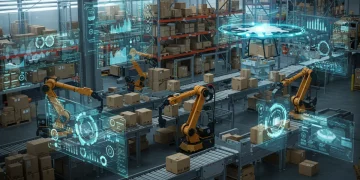
Supply Chain Revolution: 5 Technologies Boosting US Logistics by 25%

The supply chain revolution in US logistics is being driven by five transformative technologies, poised to deliver a 25% efficiency gain by 2025 by enhancing automation, visibility, and data-driven decision-making across the entire network.
The landscape of US logistics is undergoing an unprecedented transformation. We’re witnessing a profound supply chain revolution, where cutting-edge technologies are not merely incremental improvements but fundamental disruptors. This shift promises to redefine operational efficiency, aiming for a remarkable 25% gain by 2025, fundamentally altering how goods move from origin to destination across the nation.
The rise of artificial intelligence and machine learning
Artificial intelligence (AI) and machine learning (ML) are no longer futuristic concepts; they are actively reshaping the US supply chain. These technologies introduce a level of predictive analytics and automation previously unimaginable, moving logistics from reactive problem-solving to proactive optimization.
Predictive analytics for demand forecasting
One of the most significant applications of AI/ML in logistics is in predictive analytics. By analyzing vast datasets, including historical sales, weather patterns, economic indicators, and even social media trends, AI algorithms can forecast demand with remarkable accuracy. This precision helps companies avoid overstocking or understocking, which are common sources of inefficiency and cost.
- Enhanced accuracy in demand prediction, reducing waste.
- Optimized inventory levels across distribution networks.
- Dynamic pricing strategies based on anticipated market shifts.
- Improved resource allocation for transportation and warehousing.
Automated decision-making and route optimization
Beyond forecasting, AI and ML are enabling automated decision-making processes. For instance, ML algorithms can continuously analyze traffic conditions, weather, and delivery schedules to optimize routes in real-time. This not only saves fuel and time but also contributes to a more sustainable logistics operation by reducing carbon emissions.
The integration of AI and ML is fostering a truly intelligent supply chain. These systems learn from every transaction and every disruption, constantly refining their models to improve performance. This continuous learning loop is critical for maintaining competitiveness in a rapidly evolving market.
Ultimately, the adoption of AI and ML is leading to more resilient, responsive, and cost-effective supply chains. Companies leveraging these technologies are better equipped to navigate uncertainties and maintain operational excellence, setting a new standard for efficiency in the industry.
Blockchain for enhanced transparency and security
Blockchain technology, often associated with cryptocurrencies, offers groundbreaking potential for supply chain management. Its inherent characteristics of decentralization, immutability, and transparency provide a robust framework for tracking goods and information, addressing long-standing challenges in trust and visibility within complex logistics networks.
Immutable records and fraud prevention
The core benefit of blockchain in logistics is its ability to create an immutable record of every transaction and movement of goods. Each step, from raw material sourcing to final delivery, can be recorded on a distributed ledger that cannot be altered. This drastically reduces the potential for fraud, counterfeiting, and disputes, building greater trust among all participants.
- Secure and verifiable tracking of products at every stage.
- Reduced instances of fraudulent activities and product diversion.
- Simplified auditing processes with transparent transaction histories.
- Enhanced compliance with regulatory standards and industry certifications.
Improved traceability and dispute resolution
With blockchain, stakeholders can gain unprecedented traceability. Knowing the exact origin, journey, and handling conditions of a product becomes straightforward. This real-time visibility is invaluable for quality control, recall management, and ensuring ethical sourcing. When disputes arise, the transparent and verifiable records on the blockchain provide an undeniable source of truth, facilitating quick and fair resolutions.
Implementing blockchain requires a collaborative effort across the supply chain, as its full potential is realized when multiple partners adopt the technology. However, the long-term benefits in terms of reduced risk, improved efficiency, and enhanced customer confidence make it a compelling investment for forward-thinking logistics providers.
The secure and transparent nature of blockchain is poised to revolutionize how we perceive and manage supply chain integrity. It promises a future where every product’s journey is an open book, fostering unparalleled accountability and operational efficiency across the US logistics landscape.
Robotics and automation in warehouses
The integration of robotics and advanced automation in warehouses is fundamentally changing how goods are stored, retrieved, and processed. These technologies address labor shortages, increase throughput, and significantly reduce operational errors, marking a pivotal shift in warehouse management strategies.
Automated guided vehicles (AGVs) and autonomous mobile robots (AMRs)
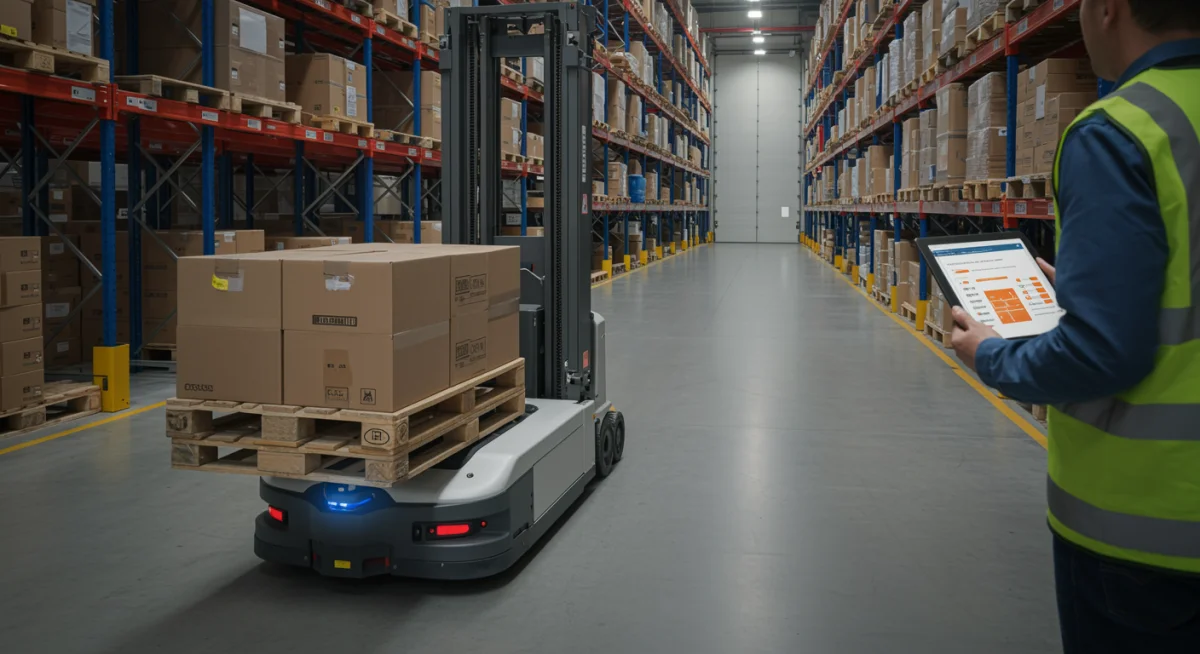
AGVs and AMRs are at the forefront of warehouse automation. These robots can transport goods, pick and place items, and even perform inventory checks without human intervention. This not only speeds up operations but also allows human workers to focus on more complex, value-added tasks. The flexibility of AMRs, in particular, allows them to navigate dynamic warehouse environments and adapt to changing layouts.
- Increased speed and accuracy in order fulfillment.
- Reduced labor costs and improved worker safety.
- Optimized use of warehouse space through precise movement.
- Scalability to handle fluctuating demand without significant human resource changes.
Automated storage and retrieval systems (AS/RS)
AS/RS solutions, ranging from carousels to mini-load systems, automate the storage and retrieval of products with high precision and speed. These systems are particularly effective in high-volume operations, maximizing storage density and minimizing retrieval times. By removing human error from the equation, AS/RS contributes to near-perfect inventory accuracy.
Beyond the robots themselves, the software orchestrating these systems is equally crucial. Warehouse Management Systems (WMS) and Warehouse Execution Systems (WES) integrate and optimize the flow of automated equipment, ensuring seamless coordination and peak performance.
The continuous evolution of robotics and automation is driving unprecedented levels of efficiency and resilience in warehouse operations. This technological advancement is not about replacing humans entirely but rather augmenting human capabilities, creating a more productive and safer work environment while meeting the ever-growing demands of modern logistics.
Internet of things (IoT) for real-time visibility
The Internet of Things (IoT) is revolutionizing supply chain visibility by connecting physical objects with digital networks. Through sensors, trackers, and smart devices, IoT enables real-time data collection and communication, offering unprecedented insights into the location, condition, and environment of goods throughout their journey.
Asset tracking and condition monitoring
IoT devices attached to shipments, vehicles, and even individual packages provide precise location tracking. This means companies can monitor their assets in real-time, anticipate delays, and provide accurate delivery estimates to customers. Beyond location, sensors can monitor critical environmental factors such as temperature, humidity, and shock, which is crucial for sensitive goods like pharmaceuticals or perishable foods.
- Real-time location data for all assets in transit.
- Continuous monitoring of product conditions to prevent spoilage or damage.
- Proactive alerts for potential issues, enabling timely intervention.
- Enhanced security through geo-fencing and unauthorized movement detection.
Optimized fleet management and inventory control
For fleet managers, IoT provides a wealth of data on vehicle performance, driver behavior, and fuel consumption. This information can be used to optimize routes, schedule maintenance proactively, and improve overall fleet efficiency. In warehouses, IoT sensors can monitor inventory levels automatically, triggering reorders and reducing the need for manual counts, thereby streamlining inventory control.
The sheer volume of data generated by IoT devices can be overwhelming, but when combined with AI and ML, this data transforms into actionable intelligence. This synergy allows for predictive maintenance, dynamic routing adjustments, and more accurate demand forecasting, further amplifying the efficiency gains.
IoT is creating a truly connected supply chain, where every component communicates and contributes to a holistic view of operations. This real-time visibility is indispensable for making informed decisions, mitigating risks, and ultimately delivering a superior customer experience.
Digital twins for simulation and optimization
Digital twins represent a sophisticated application of technology in the supply chain, creating virtual replicas of physical assets, processes, or even entire networks. These dynamic models allow companies to simulate scenarios, test changes, and predict outcomes without impacting real-world operations, leading to profound optimization capabilities.
Virtual simulation of logistics operations
A digital twin of a warehouse, for example, can simulate the impact of introducing new robotics, altering layout, or changing inventory management strategies. This virtual sandbox allows for experimentation and fine-tuning before any physical implementation, drastically reducing risks and costs associated with real-world trials. Similarly, a digital twin of a transportation network can model the effects of different routing algorithms or fleet expansions.
- Risk-free testing of operational changes and new technologies.
- Identification of bottlenecks and inefficiencies in virtual environments.
- Optimization of resource allocation and process flows.
- Accelerated decision-making based on data-driven insights.
Predictive maintenance and performance monitoring
Beyond simulation, digital twins are continuously fed real-time data from their physical counterparts via IoT sensors. This constant data flow allows the digital twin to accurately reflect the current state and performance of the physical asset. For instance, a digital twin of a delivery truck can predict when a specific component might fail based on usage patterns and sensor data, enabling proactive maintenance and minimizing downtime.
The predictive capabilities of digital twins extend to forecasting overall supply chain performance under various conditions, such as sudden demand spikes or disruptions. This foresight empowers businesses to develop robust contingency plans and maintain operational continuity.
Digital twins are transforming supply chain management from a reactive discipline into a highly proactive and predictive one. By bridging the gap between the physical and digital worlds, they unlock unparalleled opportunities for continuous optimization and resilience, ensuring the US logistics network remains agile and efficient.
The integrated future of US logistics
The true power of these individual technologies—AI/ML, blockchain, robotics, IoT, and digital twins—lies in their synergistic integration. When combined, they don’t just offer isolated improvements; they create a cohesive, intelligent, and highly optimized logistics ecosystem. This convergence is the driving force behind the projected 25% efficiency gain in US logistics by 2025.
Creating a smart, interconnected supply chain
Imagine an IoT sensor on a package detecting a temperature deviation, which then triggers an AI algorithm to re-route the shipment, updates the blockchain ledger for transparency, and informs a digital twin to simulate the impact on the entire network. This interconnectedness allows for dynamic, real-time responses to challenges, transforming potential disruptions into minor adjustments.
- Seamless data exchange across all supply chain components.
- Automated responses to unforeseen events and disruptions.
- Holistic optimization of processes from end to end.
- Enhanced collaboration among supply chain partners through shared data.
Challenges and opportunities for adoption
While the benefits are clear, the adoption of these advanced technologies presents challenges, including significant upfront investment, the need for skilled talent, and ensuring interoperability between diverse systems. However, the long-term opportunities far outweigh these hurdles. Early adopters are already seeing competitive advantages through reduced costs, faster delivery times, and greater customer satisfaction.
The integrated future of US logistics is not just about technology; it’s about a fundamental shift in mindset. It requires a commitment to innovation, data-driven decision-making, and a willingness to embrace new operational paradigms. Companies that successfully navigate this transformation will be well-positioned to thrive in the increasingly complex global marketplace.
The journey towards a 25% efficiency gain is ambitious but entirely achievable through the strategic deployment and integration of these five powerful technologies. The US logistics sector is on the cusp of a new era, one defined by unprecedented levels of intelligence, speed, and resilience.
| Key Technology | Primary Benefit in Logistics |
|---|---|
| AI and Machine Learning | Enhanced predictive analytics for demand and route optimization. |
| Blockchain | Improved transparency, security, and traceability of goods. |
| Robotics and Automation | Increased warehouse efficiency, speed, and reduced labor costs. |
| Internet of Things (IoT) | Real-time visibility into asset location and condition. |
Frequently Asked Questions about Supply Chain Technologies
AI will drive efficiency through highly accurate demand forecasting, optimizing inventory levels and reducing waste. It also enables real-time route optimization, minimizing fuel consumption and delivery times, thereby streamlining the entire transportation network and improving resource allocation.
Blockchain offers an immutable and transparent record of transactions, significantly reducing fraud and counterfeiting. It enhances traceability, ensuring product authenticity and simplifying dispute resolution by providing a verifiable history of goods, thus boosting trust among all participants.
Robotics and automation, such as AGVs and AMRs, perform repetitive and physically demanding tasks, alleviating labor shortages. They increase throughput, reduce errors, and free human workers to focus on more complex, strategic roles, ultimately enhancing overall warehouse productivity and safety.
IoT provides real-time location tracking of shipments and vehicles, along with continuous monitoring of environmental conditions like temperature and humidity. This data allows for proactive problem-solving, optimized fleet management, and precise inventory control, ensuring timely and quality deliveries.
Digital twins create virtual replicas of physical systems, allowing for risk-free simulation and testing of operational changes. They enable predictive maintenance by analyzing real-time data to anticipate failures, thereby optimizing resource allocation and enhancing overall network resilience and efficiency.
Conclusion
The confluence of artificial intelligence, blockchain, robotics, the Internet of Things, and digital twins is not merely an incremental upgrade but a fundamental re-engineering of the US logistics sector. This powerful synergy is propelling a profound supply chain revolution, laying the groundwork for an unprecedented 25% efficiency gain by 2025. By embracing these innovative technologies, businesses can expect to navigate complexities with greater agility, enhance transparency, reduce operational costs, and ultimately deliver superior service. The future of logistics is intelligent, interconnected, and poised for transformative growth, ensuring that the movement of goods across the nation becomes more streamlined and resilient than ever before.